Claude Fable 5 Shows How Frontier AI Is Changing
Anthropic’s Claude Fable 5 and Mythos 5 show how frontier AI is shifting toward longer tasks, trusted access, and safer release strategies.
Anthropic has introduced Claude Fable 5 and Claude Mythos 5, and the announcement shows how quickly the artificial intelligence market is changing. This is not just another model release with better benchmark scores and a few new features. It is a sign that the most advanced AI systems are becoming useful for longer, more complicated work that used to require entire teams. It also shows that AI companies are starting to treat access, safety, and trust as major parts of the product itself.
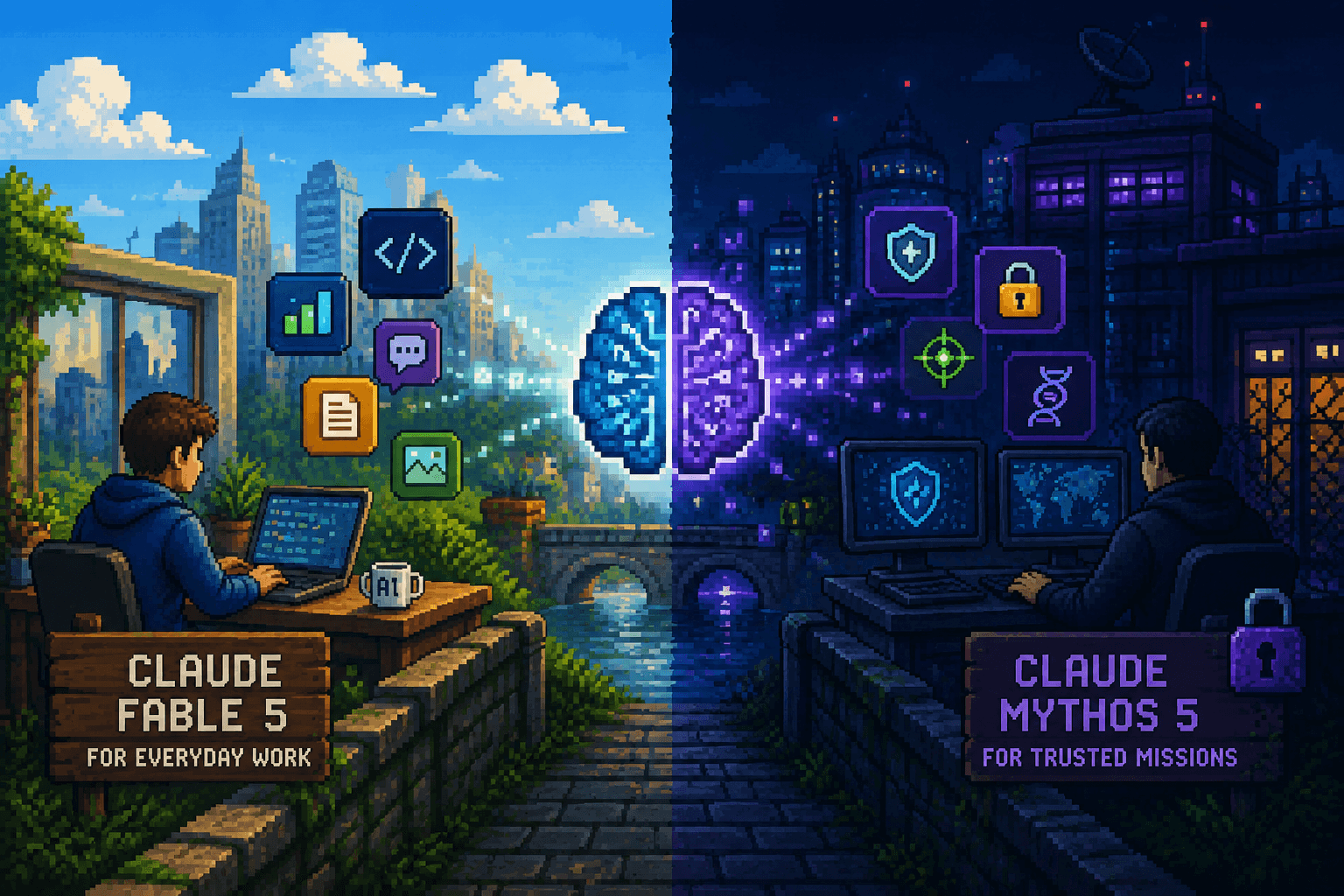
Claude Fable 5 is the version built for general use. Anthropic describes it as a Mythos-class model that has been made safe enough to release broadly. The company says it performs especially well in software engineering, knowledge work, vision, scientific research, and long-running tasks. That matters because the future of AI is not only about getting faster answers, but about helping people complete bigger projects with more context and fewer restarts.
AI is moving beyond simple tasks
For a long time, most people used AI for quick work. They asked it to write an email, summarize a document, explain a topic, clean up a paragraph, or help with a small coding problem. Those uses are still helpful, but they are no longer the most interesting part of the market. The more important shift is toward AI systems that can stay focused through long tasks, understand messy information, and help move real projects forward.
Claude Fable 5 appears to be aimed at that next stage. Anthropic says the model has a bigger advantage on longer and more complex work, which is where many older AI tools start to struggle. That could make it more useful for developers, analysts, researchers, and teams working across large amounts of information. Instead of using AI as a simple assistant, more businesses may start using it as a serious work layer inside their normal operations.
Software development is one of the clearest examples. Anthropic highlighted early testing where Fable 5 helped with large codebase work, including complicated migrations and production-level coding tasks. That type of work is usually slow, repetitive, and expensive, especially when engineers have to understand old systems before making changes. If models like Fable 5 can handle more of that work reliably, they could change how companies approach maintenance, refactoring, testing, and internal tooling.
The same idea applies outside of engineering. Anthropic also points to stronger performance in finance tasks, document reasoning, chart interpretation, vision work, memory, and scientific research. These are areas where a model needs to do more than generate a clean-sounding answer. It needs to follow the problem, understand the source material, compare details, and avoid losing track of the goal. That is why long-context and long-horizon work is becoming such an important part of the AI race.
Safety is becoming part of the release strategy
The most important part of the announcement may be how Anthropic is releasing the model. Claude Fable 5 is generally available, but it does not give every user the full power of the underlying system in every situation. Anthropic says certain requests related to cybersecurity, biology, chemistry, and model distillation may be routed to Claude Opus 4.8 instead. The company says this is meant to reduce the risk of misuse while still giving users a useful response instead of a hard refusal.
That tells us something important about where AI is going. As models get stronger, companies will probably move away from one-size-fits-all access. A general user may get a powerful model with extra safeguards, while a trusted organization may get more advanced access for a specific use case. That setup may feel frustrating at times, especially if harmless requests are flagged by safety systems, but it also reflects the reality of more capable AI.
Anthropic says these safeguards are tuned conservatively, which means they may catch some requests that are not actually dangerous. That tradeoff is not perfect, but it is easy to understand. A model that can help with cybersecurity defense could also help with offensive cyber work if used the wrong way. A model that can speed up life sciences research could also raise concerns if it gives too much help on risky biological or chemical tasks.
This is why the Fable and Mythos split matters. Claude Fable 5 is the broadly available version with more safety controls. Claude Mythos 5 is the more restricted version for trusted groups, including cyberdefenders and infrastructure providers. Anthropic is clearly trying to find a middle ground where advanced AI can be used for valuable work without making the riskiest capabilities available to everyone in the same way.
Mythos 5 points to a controlled access future
Claude Mythos 5 is the same underlying model as Fable 5, but with some safeguards lifted for approved users. Anthropic says it is being used first through Project Glasswing with cyberdefenders and infrastructure providers. The company also plans to expand trusted access for certain biology researchers and organizations. That means Mythos 5 is not being positioned as a normal consumer model, but as a controlled tool for groups that can use the stronger capabilities responsibly.
This approach makes sense, but it also raises bigger questions for the industry. If the most advanced AI systems are limited to trusted access programs, companies will need clear rules for who qualifies and why. They will also need to prove that these programs are not just a way to give powerful tools to a small group of insiders. Access decisions could become one of the most important parts of frontier AI, especially in areas like security, science, medicine, and infrastructure.
There is also a practical business angle. Not every company needs the strongest model for every task. Some work can be handled by cheaper, faster, or more specialized systems. But for complicated work where accuracy, context, and autonomy matter, businesses may be willing to pay more for a model that can handle difficult projects with fewer mistakes.
Claude Fable 5 and Mythos 5 are both priced at premium API rates, which makes that decision more important. Businesses will need to think carefully about when a top-tier model is worth using. A simple summary or basic draft may not need the most advanced option. But complex analysis, codebase work, legal review, research, and high-value internal projects may justify the cost if the model saves enough time or improves the quality of the work.
What this means for businesses
For businesses, the main takeaway is that AI is becoming more useful for serious work. The strongest models are not just better chatbots. They are starting to look more like systems that can help with planning, analysis, coding, review, research, and execution. That does not remove the need for people, but it can change what people spend their time doing.
The companies that benefit most will not be the ones that simply give every employee a chatbot and hope for the best. They will be the ones that build clear workflows around AI. That means giving the model strong instructions, clean source material, specific goals, and a review process. It also means knowing when AI should assist, when it should draft, and when a human needs to make the final call.
There is still a trust issue that businesses cannot ignore. A more capable model can be more useful, but it can also create bigger problems if it makes a mistake or is used in the wrong place. Teams will need policies around sensitive data, legal review, security work, customer communication, and final approvals. AI can make work faster, but speed only helps if the process still protects quality and accountability.
That is why Anthropic’s announcement feels bigger than a normal model launch. It shows that the AI market is entering a stage where capability, access, cost, and safety are all connected. The most powerful models will not just be judged by how smart they are. They will also be judged by how safely and practically they can be used in the real world.
The main takeaway
Claude Fable 5 shows that frontier AI is moving into a more serious phase. These systems are being built for longer tasks, deeper reasoning, and more complex work across software, finance, science, and business operations. At the same time, Claude Mythos 5 shows that the strongest capabilities may not be released to everyone in the same way. The future of AI may be less about one model for all users and more about different levels of access for different levels of trust.
That may become one of the defining patterns of advanced AI. Most users will get powerful systems with strong safeguards. Trusted organizations may get deeper access for specific high-value or high-risk work. AI companies will have to balance speed, safety, usefulness, and control as the models continue to improve.
Anthropic’s launch makes that direction clear. AI is getting more capable, but the release strategy is becoming just as important as the model itself. Businesses should pay attention because this is where the market is going. The next stage of AI will be about completing real work, managing real risk, and deciding who gets access to the most powerful tools.